
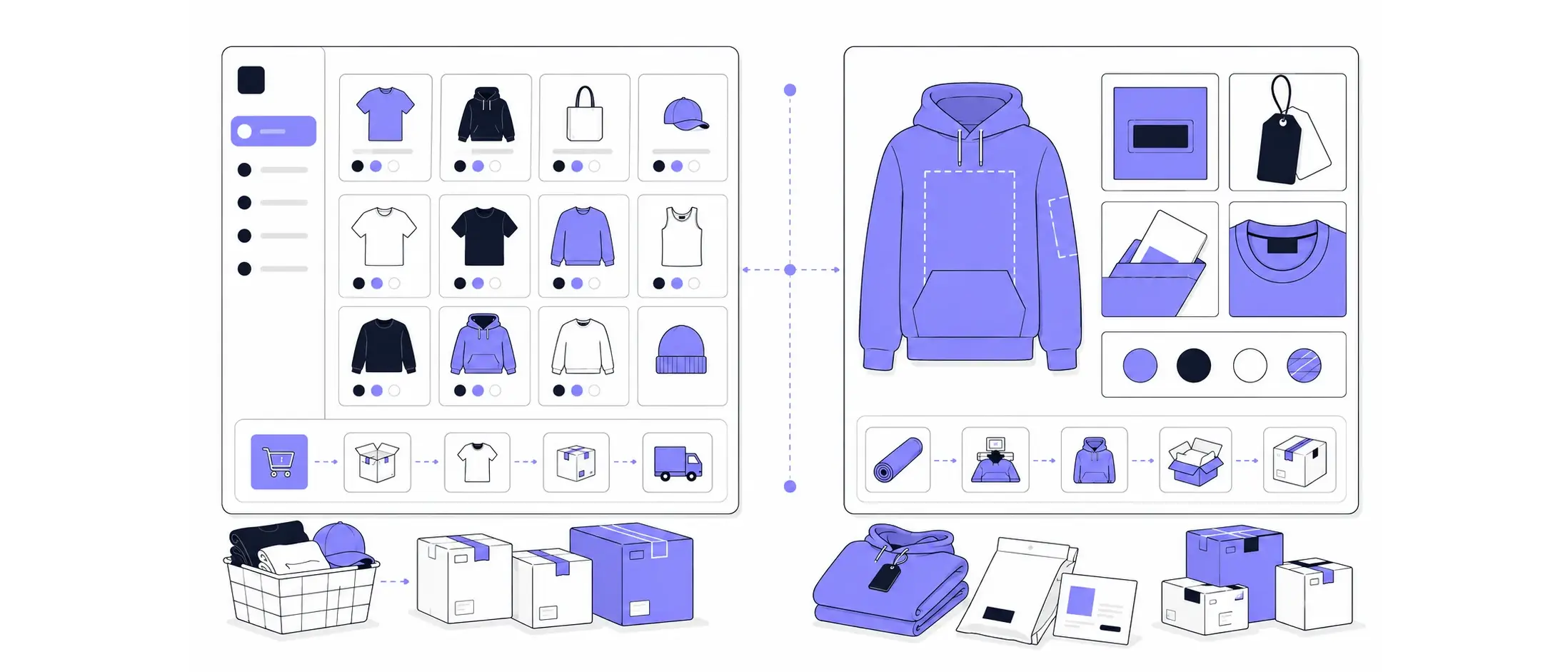
Short answer: Printful is the stronger all-round print-on-demand platform for sellers who want a broad catalog, mature integrations, global fulfillment, and a large public track record. PODpartner is a strong Printful alternative for apparel-first brands that need heavyweight blanks, oversized print areas, hybrid decoration, custom branding, and tighter control over the garment itself.
For general POD stores, Printful usually fits better.
For clothing brands, especially streetwear-style stores, PODpartner deserves a closer look.
Quick comparison
| Category | Printful | PODpartner |
|---|---|---|
| Best for | General POD sellers, creators, ecommerce stores, broad product testing | Apparel-first brands, streetwear sellers, brand-builders |
| Product range | Broad catalog across apparel, accessories, home goods, wall art, drinkware, and more | Apparel-focused catalog |
| Apparel positioning | Strong general apparel options | Heavyweight blanks, oversized cuts, washed effects, and brand-focused apparel details |
| Print areas | Depends on product and print method | 21+ print areas per garment on supported products |
| Max jumbo print | Product/method dependent | Up to 24” × 24” Jumbo DTG on supported apparel |
| Decoration | DTG, embroidery, DTF, AOP, labels, branding options | DTG, Jumbo DTG, embroidery, HTV, and hybrid decoration on one garment |
| Embroidery | Available on selected products | DST format supported, up to 15 colors, max 12” × 12” |
| HTV | Product/method dependent | HTV lettering film with 6 material options |
| Branding | White-label fulfillment, labels, inserts, branding extras | Custom neck labels, hang tags, branded poly bags, free Shopify personalization |
| Fulfillment | Broad fulfillment network; most orders fulfilled in 2–5 business days | In-house apparel production, around 2-day production, public delay-compensation policy |
| Integrations | Large integration ecosystem | Shopify, Etsy, Wix, WooCommerce, Squarespace |
| Best choice | Sellers who need mature, broad POD infrastructure | Sellers who need deeper apparel production and branding options |
Product range: broad POD catalog vs apparel focus
Printful is the better choice when product range matters most.
Its catalog covers much more than clothing. A seller can build a store around T-shirts, hoodies, hats, mugs, posters, bags, phone cases, blankets, wall art, embroidered products, and other categories. That makes Printful useful for creators, small ecommerce brands, corporate merch, gift stores, artists, and general POD experiments.
PODpartner is more focused on clothing. Its catalog is built around apparel categories such as T-shirts, long sleeves, hoodies, sweatshirts, tank tops, jackets, shorts, and pants.
That focus gives PODpartner a different role in the POD market. It puts more emphasis on garment weight, fit, print area, decoration, labels, packaging, and reorder consistency.
A broad gift store will usually fit Printful better.
A heavyweight hoodie or streetwear brand may fit PODpartner better.
Sellers comparing hoodie suppliers can also use our hoodie print-on-demand supplier comparison for broader context.
Apparel blanks and product feel
Many POD products begin with standard blanks from third-party apparel suppliers. That works for many sellers. A simple T-shirt or hoodie can sell well when the design, audience, and offer are right.
Printful gives sellers a mature way to launch those products quickly. Its catalog, integrations, mockups, fulfillment workflow, and documentation make it one of the easiest choices for general POD.
PODpartner approaches apparel from a more production-focused angle. It owns both garment production and print production, and produces its own blanks and silhouettes. That matters for sellers who care about more than the uploaded artwork.
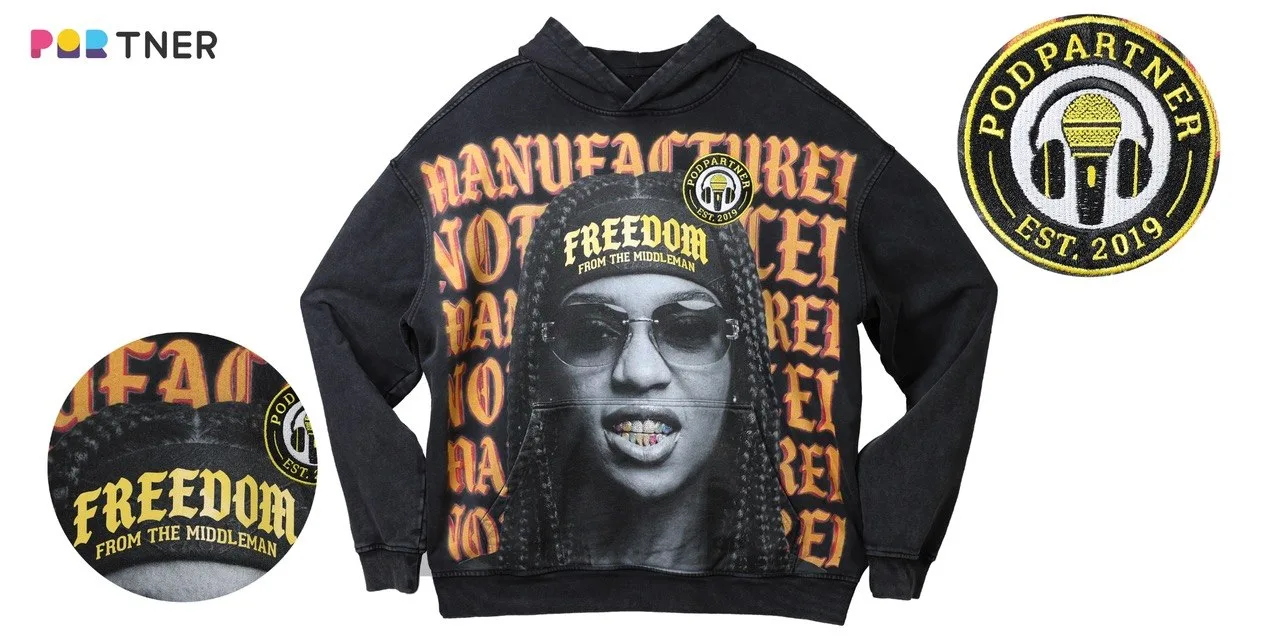
PODpartner’s public materials and product catalog emphasize heavyweight blanks, oversized fits, washed effects, and batch consistency. Examples include 440GSM hoodies and 425GSM oversized T-shirts.
For low-price T-shirt testing, Printful is usually more practical.
For premium apparel, PODpartner’s blank and decoration options become more relevant.
For T-shirt-specific research, browse our T-shirt POD supplier directory.
Print size and decoration options
PODpartner has its clearest advantage in print size and apparel decoration.
Printful supports a strong range of print methods, including DTG, embroidery, DTF, and all-over print, depending on product. That gives most sellers enough flexibility for standard T-shirts, hoodies, hats, mugs, and basic merch.
PODpartner puts more emphasis on large apparel canvases and mixed decoration. Its supported apparel can use 21+ print areas per garment, with Jumbo DTG up to 24” × 24”.
That matters for sellers designing streetwear-style pieces, oversized front or back graphics, neck-to-hem layouts, multi-panel designs, or garments that combine print and stitch.
PODpartner is especially relevant for:
- oversized front or back graphics
- multi-area apparel designs
- Jumbo DTG up to 24” × 24”
- embroidery using DST files, up to 15 colors, max 12” × 12”
- HTV lettering film with 6 material options
- DTG plus embroidery plus HTV on one garment
- branded neck labels, hang tags, and packaging
These options give apparel sellers more room to make the garment feel like a designed product, rather than a standard blank with a single print placement.
Branding and packaging
Both suppliers support branded selling, but PODpartner puts those details closer to the center of the offer.
Printful has mature white-label fulfillment and branding options. Sellers can use labels, packaging inserts, and other paid extras depending on product and availability. That works well for stores that want a cleaner brand experience without handling fulfillment.
PODpartner’s Shopify listing and public materials emphasize custom neck labels, hang tags, branded packaging bags, and personalization. Its Shopify personalization feature is free, which is useful for apparel sellers who want to offer customer-specific text or details without adding extra manual work.
For apparel brands, those details matter. A hoodie with a branded label, custom hang tag, and intentional packaging creates a stronger retail impression than a plain fulfillment experience.
For novelty shirts, the niche and design may matter more than packaging.
For brand-led apparel, packaging and labels are part of the product.
Pricing and margins
Printful is free to start, with paid Growth features available. Its base product price usually includes the blank product, one print or embroidery placement, and fulfillment. Shipping, taxes, and extras such as additional placements, labels, or digitization are separate.
PODpartner is also free to install on Shopify, with fulfillment and shipping charges applied when products are sold. Its catalog examples show apparel base prices that are often higher than basic commodity POD blanks, especially for heavyweight products.
That pricing reflects the product type. A heavyweight oversized hoodie sits in a different category from a basic low-cost hoodie blank.
The practical question is simple: which supplier fits the product and retail price you want to sell?
For low-price products, simple designs, and fast SKU testing, Printful is usually the easier fit.
For heavier apparel, oversized prints, custom branding, and higher retail prices, PODpartner may fit the margin structure better.
A seller trying to retail a hoodie at $35–$45 may struggle with premium-heavyweight POD economics. A seller building a streetwear-style hoodie at $65–$90 has more room for better blanks, larger decoration, and branded details.
PODpartner’s strongest pricing case is premium apparel, rather than low-cost merch.
Fulfillment and shipping
Printful has a broad fulfillment network, a long operational history, and public documentation around fulfillment and shipping. Most Printful orders are fulfilled in 2–5 business days, with shipping time added afterward. For sellers shipping to a wide range of countries, that maturity matters.
PODpartner’s fulfillment story is more apparel-production focused. Its vertically integrated setup combines garment production and print production, which can help with quality control, batch consistency, and faster in-house production. PODpartner cites around 2-day in-house production and has a public delay-compensation policy for eligible late orders.
PODpartner is listed in our supplier directory with headquarters in Shenzhen, China, and China-based factory locations. For sellers, that is part of the operating model: access to a vertically integrated apparel setup with tighter production control and faster in-house production, while still making it worth testing samples, shipping speed, tracking, packaging, and customer communication for the target market.
For US and EU sellers, the operational question is whether the product quality and brand control justify the production and shipping model for the target customer.
Premium apparel may justify that trade-off. Low-price, time-sensitive merch may fit Printful better.
Integrations and platform maturity
Printful has the advantage in platform maturity.
It integrates with many ecommerce platforms and marketplaces and is one of the most familiar POD names for Shopify, Etsy, WooCommerce, Amazon, eBay, and creator-led ecommerce stores.
PODpartner supports major ecommerce platforms including Shopify, Etsy, Wix, WooCommerce, and Squarespace. For many apparel sellers, especially Shopify stores, that may be enough.
Printful has more public documentation, more user history, more app reviews, and more third-party discussion around its workflow. PODpartner has a smaller public footprint, so sellers should test the actual workflow before moving a full apparel line onto it.
Sellers choosing sales channels can also compare Shopify vs Etsy for print-on-demand stores.
Main limitations
Printful limitations
Printful’s broad catalog can make it feel less specialized for clothing brands.
For sellers building a specific apparel identity, product templates, available blanks, print-placement limits, and premium branding costs can become constraints.
Printful can support serious apparel brands, especially in early stages. PODpartner becomes more relevant when heavyweight blanks, oversized print formats, hybrid decoration, and brand packaging are central to the product.
PODpartner limitations
PODpartner fits apparel-first sellers better than broad POD stores. Sellers who want to test many categories across home decor, accessories, mugs, posters, and apparel will usually get more flexibility from Printful.
Sellers should also test samples before scaling. PODpartner’s best case depends on apparel quality, decoration, and brand presentation, so those details should be judged directly.
Best-fit seller types
Choose Printful if:
- you want a broad POD catalog
- you want many integrations and marketplace options
- you sell more than apparel
- you want a large public review base
- you need mature, general-purpose POD infrastructure
- you want simple setup and predictable documentation
- you are testing many designs or product categories
Consider PODpartner if:
- your store is apparel-first
- you want heavyweight blanks and oversized fits
- your designs need larger print areas
- you want DTG, embroidery, HTV, or hybrid decoration on one garment
- you care about custom labels, hang tags, and branded packaging
- you are building a clothing brand rather than a general merch store
- you are comfortable testing samples and shipping before scaling
What to read next
- For more supplier options by apparel category, browse the print-on-demand supplier directory .
- For hoodie-specific suppliers, compare the best print-on-demand hoodie suppliers .
- For marketplace sellers, read the Etsy print-on-demand provider guide .
- For broader platform research, read the Printful vs Printify vs Gelato comparison .
FAQ
Is PODpartner a good Printful alternative?
Yes, PODpartner is a strong Printful alternative for apparel-first brands. Printful is broader and more mature as a general POD platform, while PODpartner is more focused on clothing, heavyweight blanks, large print areas, decoration options, and branding details.
What print areas and print sizes does PODpartner support?
PODpartner supports 21+ print areas per garment on supported products. Its Jumbo DTG option supports prints up to 24” × 24”, which is useful for oversized graphics, streetwear-style designs, and multi-location apparel layouts.
Does PODpartner offer embroidery and hybrid decoration?
Yes. PODpartner supports embroidery using DST files, up to 15 colors, and a max embroidery size of 12” × 12”. It also supports hybrid decoration, including DTG, embroidery, and HTV on one garment.
Which platforms does PODpartner integrate with?
PODpartner integrates with Shopify, Etsy, Wix, WooCommerce, and Squarespace. Shopify sellers also get access to free personalization, which can be useful for custom apparel products.
Which supplier is better for general POD testing?
Printful is usually the better fit for general POD testing because it has a broader catalog, more integrations, and more public operating history. Sellers testing many product types will usually get more flexibility from Printful than from an apparel-focused supplier.
Final recommendation
Printful and PODpartner serve different seller profiles.
Printful fits sellers who need broad POD coverage, many product categories, a mature integration ecosystem, and a large public track record. It is the better option for general merch stores, creators testing many product types, and sellers who want one supplier for more than apparel.
PODpartner fits sellers building apparel-first brands. Its strongest case is control over the garment: blank weight, fit, print area, decoration method, labels, packaging, and reorder consistency.
Use Printful when you need broad POD infrastructure.
Test PODpartner when your apparel line depends on heavier blanks, large-format artwork, branded finishing, and more control over the garment.