
Can you sell print-on-demand products in Europe with Gelato?
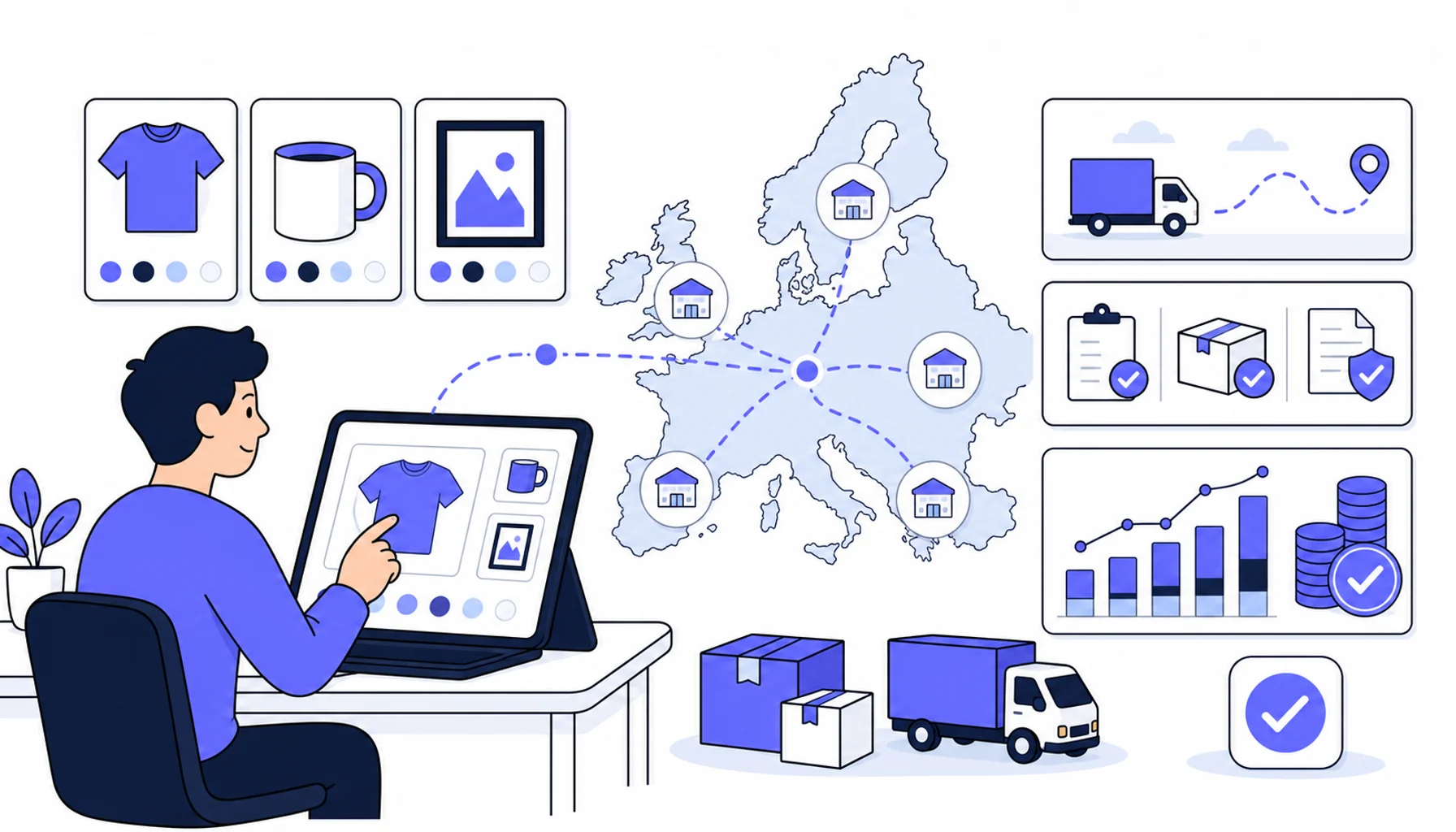
You can sell print-on-demand products in Europe with Gelato by connecting a store such as Etsy, Shopify, or WooCommerce, publishing products from Gelato’s catalog, and letting Gelato route each order to a production partner close to the customer when local production is available.
The advantage is operational. A product printed closer to the buyer can reduce delivery distance, shorten shipping times, lower cross-border friction, and make delivery promises more realistic. That matters in Europe because a seller may be dealing with multiple countries, currencies, VAT rules, shipping expectations, and buyer languages.
Gelato currently positions its network around local production in 32 countries, 140+ print providers, and local routing for most orders. That makes it especially relevant for sellers targeting EU and UK buyers, or sellers outside Europe who still want European customers to receive products through a more local fulfillment path.
The business still needs proper pricing, product selection, tax awareness, and channel discipline. Local fulfillment improves the operating model. It does not create demand by itself.
Why Europe is different for POD sellers
Selling to Europe is different from selling only inside one domestic market. Even if the products are simple, the operating layer is more complex.
A European POD seller may need to think about:
- different VAT rates by country;
- marketplace fees and payment-processing fees;
- cross-border shipping times;
- import VAT and customs handling when goods enter from outside the buyer’s region;
- buyer expectations around delivery dates;
- return and replacement handling;
- language and localization;
- packaging or product-compliance requirements in some markets.
The practical issue is usually not whether a seller can technically ship to Europe. Many providers can ship internationally. The harder question is whether the delivery promise, landed cost, and customer experience still make sense after the full cost stack is counted.
If you are still checking the basic economics, start with Gelato pricing and profit margins. Margin comes before expansion.
What local fulfillment changes
Local fulfillment changes five things that matter to sellers.
| Area | Why it matters |
|---|---|
| Delivery time | Buyers are more likely to trust shorter, realistic delivery windows. |
| Shipping cost | Shorter routes can reduce the pressure to charge high shipping or absorb it into the product price. |
| Customs friction | Products made inside the buyer’s region are less likely to create import-style surprises for the customer. |
| Replacement speed | Reprints and replacement orders are less painful when fulfillment is closer to the buyer. |
| Sustainability story | Local production can reduce transport distance and waste compared with centralized bulk production. |
This is the core reason Gelato is interesting for Europe. A seller in Germany, the UK, or the US can sell to a customer in France, Sweden, or the Netherlands without automatically thinking in terms of one warehouse shipping everywhere.
Local production still depends on the product. A poster may be available locally in more countries than a specific hoodie color or niche product. Always check the product, country, and shipping route before building a whole offer around it.
Gelato’s Europe fit
Gelato is strongest when your product fits its local-production network.
Good fits usually include:
- posters;
- wall art;
- framed prints;
- mugs;
- core apparel;
- personalized gifts;
- simple products with broad regional availability.
This is why Gelato often makes sense for Europe-first sellers. The catalog is broad enough for common POD categories, but the main advantage is routing, not endless product variety.
A seller focused on European wall art, for example, may care more about print quality, delivery time, and local production than about having 1,000 product types. A seller building a niche t-shirt catalog may care more about base cost, available blanks, color range, and exact product control.
For a broader provider-level view, use the Gelato supplier profile and compare it against Printify vs Gelato if supplier choice matters.
VAT and customs: what sellers should understand
European VAT and customs rules can affect your profit and the customer experience. This section is a practical overview, not tax advice.
For a POD seller, the key distinction is where the product is produced and where it is delivered.
Scenario 1: Product made inside the buyer’s region
If a product is produced inside the EU for an EU customer, the order usually avoids the customer-facing experience of a parcel being imported from outside the EU. That can reduce friction around customs handling, delays, and surprise import charges.
The seller still needs to understand VAT, marketplace rules, and local obligations. Local production helps the fulfillment route. It does not remove every tax question.
Scenario 2: Product imported into the EU
If a product is shipped into the EU from outside the region, import VAT and customs handling can become visible to the buyer depending on the sales channel, seller setup, product value, and carrier process.
That can hurt conversion and reviews. A buyer who expects a simple delivery may react badly to extra charges, delays, or paperwork after checkout.
Scenario 3: Selling into the UK
The UK is separate from the EU VAT/customs system. A UK buyer is not the same as an EU buyer from an operational standpoint. Local UK production can still be valuable because it can reduce cross-border movement, but sellers should check UK-specific VAT and marketplace handling separately.
Practical rule
Do not sell internationally first and understand the tax and shipping model later. Before scaling a product into Europe, check:
- where the product is produced;
- which countries it can be produced in;
- whether the sales channel collects VAT or tax in your case;
- whether the buyer may see import charges;
- what the delivery estimate says for each target country;
- whether the product margin still works after tax, fees, and shipping.
If you sell on Etsy, remember that marketplace costs can be significant. Etsy charges listing fees, transaction fees, payment-processing fees, and sometimes Offsite Ads fees. These need to be included before judging whether a product is profitable.
Shipping risk: the hidden cost in European POD
Many sellers compare only base product cost. That is too shallow for European POD.
A cheaper product can become more expensive after shipping. A cheaper route can create slower delivery. A slower delivery can create more support tickets, refunds, and bad reviews. The cost is not always visible in the product table.
For Europe, compare providers by landed cost and delivery promise, not base cost alone.
Use this simple checklist:
- Pick your main buyer country.
- Check the product’s production and shipping route.
- Calculate landed cost.
- Add marketplace and payment fees.
- Add an allowance for ads or acquisition.
- Check whether the customer-facing delivery estimate is believable.
- Order a sample into the target region.
- Publish only after the sample and margin both pass.
The POD landed-cost index is useful here because it compares product cost and delivery estimates by supplier and destination. Product base cost alone is not enough.
Gelato vs Printify for European sellers
Printify and Gelato solve different problems.
Printify gives sellers more choice. You can choose between many products and print providers, which is valuable if you want a broad catalog, very specific blanks, or supplier-by-supplier control. That flexibility can improve margins if you choose well. It can also create more operational work.
Gelato gives sellers a simpler local-routing model. You usually do not choose a specific print provider for every SKU. Gelato’s system routes orders through its network. That can be better for sellers who want fewer fulfillment decisions and stronger European delivery logic.
For Europe-focused sellers, the decision often looks like this:
| Seller priority | Better starting point |
|---|---|
| Local fulfillment and simpler routing | Gelato |
| Maximum catalog variety | Printify |
| Choosing exact print partners | Printify |
| Faster setup with fewer supplier decisions | Gelato |
| Testing many niche products | Printify |
| Selling common products across several European countries | Gelato |
A European seller using Printify should pay close attention to the print provider selected for each product and destination. A European seller using Gelato should pay close attention to whether the exact product is locally available in the target country.
Gelato vs Printful for European sellers
Printful is usually strongest when branding, consistency, and a more controlled seller experience matter. It has a curated feel and strong brand-friendly features. That can be valuable for sellers building a premium Shopify store or a creator brand.
Gelato is usually strongest when regional fulfillment and international delivery speed are the main constraint. It is more explicitly built around local production and distributed routing.
The choice depends on the business model:
| Seller priority | Better starting point |
|---|---|
| Regional fulfillment across Europe | Gelato |
| Brand-first experience | Printful |
| Packaging and brand presentation | Printful |
| Local production story | Gelato |
| Simpler international shipping logic | Gelato |
| More controlled fulfillment experience | Printful |
For deeper comparison, use Printful vs Gelato. For many sellers, the answer may be using more than one provider: Gelato for Europe-heavy products, Printful for brand-sensitive SKUs, and Printify for catalog expansion.
Best product strategy for selling POD in Europe with Gelato
Start narrow. Europe is too broad to treat as one market in the beginning.
A practical first test:
- one product category;
- one main buyer region;
- one store channel;
- 5 to 10 listings;
- one consistent pricing rule;
- one sample order;
- one clear delivery promise.
For example:
- German or EU wall art store using posters and framed prints;
- UK-focused gift shop using mugs and personalized products;
- Etsy shop selling localized occasion gifts;
- creator brand selling apparel to fans across EU and UK;
- Shopify store with an existing audience and region-specific product pages.
Gelato can support broader international selling, but the first test should be controlled. If Germany works, expand to nearby countries. If posters work, test framed prints or canvas. If one niche works, create adjacent designs before jumping into a new audience.
How to set delivery expectations
Delivery promises affect conversion and reviews. Sellers should avoid aggressive delivery claims until real orders prove the route.
Use this process:
- Check Gelato’s estimated delivery for the product and destination.
- Add a small buffer at the beginning.
- Test with a sample order.
- Monitor actual production and shipping time.
- Tighten delivery promises only after you see consistent results.
On Etsy, this matters because buyers compare delivery dates before buying. On Shopify, it matters because the seller owns the customer support burden. A delivery promise that creates refunds and support tickets is not a growth lever.
If your main buyer channel is Etsy, also read the best POD providers for Etsy sellers. The right provider is partly about product quality, partly about how well the workflow holds up after orders start.
Sustainability: useful, but keep it specific
Gelato’s sustainability argument is tied to local production. Products made closer to the buyer can reduce transport distance and the waste associated with overproduction, because items are produced only after an order is placed.
That is a legitimate part of the story, especially for European buyers who care about delivery distance and waste. Keep the claim specific. Say local production can reduce shipping distance and inventory waste. Avoid vague claims that every product is automatically sustainable.
A strong seller message would be:
Printed on demand, closer to the buyer when local production is available.
A weak message would be:
This product is sustainable because it uses Gelato.
Customers trust specific operational claims more than broad eco language.
When Gelato is a good fit for Europe
Gelato is a good fit if:
- your buyers are in several European countries;
- local delivery speed matters to conversion or reviews;
- you sell common POD products with strong local availability;
- you want fewer supplier-routing decisions;
- your product margin survives landed cost and marketplace fees;
- you want a local-production sustainability angle;
- you are building around Etsy, Shopify, WooCommerce, or another supported channel.
Gelato may be a weaker fit if:
- you need very specific blanks or niche products;
- you want to choose each print provider yourself;
- your product category has limited local availability;
- your margins are too thin after shipping and fees;
- your main buyer market is concentrated in one country with a better specialist supplier.
Step-by-step: selling POD in Europe with Gelato
- Choose your first market. Start with one primary region, such as Germany, France, the Netherlands, the UK, or EU-wide Etsy buyers.
- Choose one product category. Posters, wall art, mugs, and common apparel are easier starting points than obscure products.
- Check local availability. Confirm the product can be fulfilled close to your target buyers.
- Calculate landed cost. Include production, shipping, marketplace fees, payment processing, and a replacement allowance.
- Pick a sales channel. Etsy is useful for marketplace demand. Shopify gives more control if you already have traffic. Compare Shopify vs Etsy before committing.
- Order a sample into the target region. Check print quality, delivery time, packaging, and whether the retail price feels justified.
- Publish a small batch. Use 5 to 10 related listings, not one random product.
- Track real signals. Watch impressions, clicks, add-to-carts, sales, delivery timing, and support issues.
- Adjust pricing or product selection. Fix weak margins before scaling.
- Expand only after proof. Add nearby regions, adjacent product types, or higher-value variants after the first test works.
Bottom line
Gelato is one of the stronger print-on-demand options for Europe because its model is built around local production and regional delivery. That can help sellers reduce delivery friction, shorten shipping routes, improve customer experience, and support a more specific sustainability story.
The business still depends on product-market fit, margin math, channel choice, and execution. VAT, customs, marketplace fees, and delivery expectations still need attention.
For most Europe-focused sellers, Gelato is worth testing when the product is locally available, the margin survives landed cost, and delivery speed is part of the selling proposition. Start with one product, one market, and one channel. Prove the route before scaling.
FAQ
Is Gelato good for selling print on demand in Europe?
Yes, Gelato is a strong option for Europe-focused POD sellers when the product can be produced close to the buyer. Its local-production network can reduce delivery distance, shipping friction, and customer-facing delays.
Does Gelato handle VAT for European sellers?
Gelato may show applicable VAT and tax at checkout for orders placed through its system, but sellers still need to understand their own VAT and marketplace obligations. VAT treatment depends on seller location, buyer location, channel, product value, and fulfillment route.
Does local production avoid customs issues?
Local production can reduce customer-facing customs friction when the item is produced inside the buyer’s region. If a product is shipped from outside the EU or UK into the buyer’s country, import VAT, duties, or carrier handling can still become relevant.
Is Gelato better than Printify for Europe?
Gelato is often better when local fulfillment and simpler routing are the priority. Printify can be better when catalog variety, exact print-provider choice, or niche product selection matters more.
Is Gelato better than Printful for Europe?
Gelato is often stronger for Europe-wide local production and regional delivery logic. Printful can be stronger for branding, packaging, and a more controlled brand-first seller experience.
What products should I sell in Europe with Gelato?
Wall art, posters, mugs, common apparel, and personalized gifts are practical starting points. Check local availability, landed cost, and delivery estimate before committing to a product category.
Should I start with Etsy or Shopify for selling Gelato products in Europe?
Etsy is usually easier for testing marketplace demand. Shopify gives more control but requires your own traffic source. A beginner can often test faster on Etsy, while an existing brand or creator may prefer Shopify.
Disclosure: This article contains affiliate links and sponsored content. We may receive compensation when you click links or make purchases through our recommendations. This does not affect our editorial opinions.